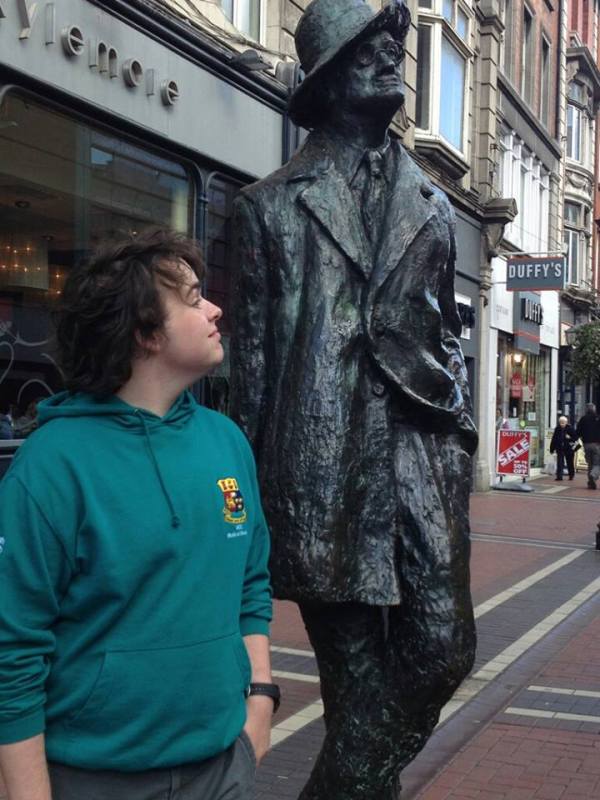
James Joyce and Me: Bloomed from curiosity

In the summer before beginning the final year of my undergraduate degree I started considering which modules I would like to study. As a Single Honours BA in English student I would also be taking on 2 special studies seminars, smaller classes focusing on an area of literature in-depth. Previously I had studied the works of Oscar Wilde and Arthurian Literature and both classes were indeed the highlight of my 2nd year.

The 3rd year seminars proved to be no less interesting, with a wide selection of topics covered by the lecturers of UCC English. I spent hours considering which 2 would be best suited to my interests, yet the one that stood out to me was the seminar entitled “Reading Ulysses

Like most students of literature I had of course heard of James Joyce’s infamously difficult book before, though I had never even attempted to read it in my own time. For final year I particularly wanted to focus on my main area of interest: modern literature (which is what I would eventually end up specializing in for the MA that brings me to this blog) and Ulysses is regarded as one of the greatest works of Modernism, thus I knew there would be some very useful overlapping between the seminar and the modules I was studying.

Aside from this the real reason why I had chosen to study such a seemingly difficult text in the first semester of my final year was simply I was curious. Was the book as challenging as people perceive? I had heard lecturers and fans of the book praising its style and humor, what would my overall opinion be at the end?

To put it simply I can say without a doubt studying Joyce’s Ulysses was one of the most fulfilling experiences of my undergraduate degree. Each week the class group would read and analyse a different chapter (or “episode”) from the text and discuss it at length, it truly is a work that lends itself greatly to group discussion. I had experienced other works from Joyce prior to undertaking the seminar; in 1st year I read his collection of short stories Dubliners and have since seen two stage adaptations of The Portrait of the Artist as a Young Man. Like many of the Modernist writers; T.S. Eliot, Gertrude Stein etc. Joyce’s works are very well suited to the stage and being read aloud, like they were written to be heard as well as read. Following on from my positive experience of studying his magnum opus I attended “Bloomsday” on June 16th, the single day of the events of book now a yearly celebration of Joyce in Dublin. I heard many such readings and performances, now truly appreciating how much of an impact on Irish culture Ulysses has had.

As part of my MA, I find myself returning to the long difficult book I chose to study simply out of curiosity. Though I have once again enjoyed discussing it with my classmates and hearing their ideas and interpretations I do not see it as a potential thesis topic, as I wish to explore other areas. However, James Joyce’s story about the ordinary day shared by Leopold Bloom, Molly Bloom and Stephen Dedalus that has been read and loved by countless people will always be one of the most memorable and influential parts of my growth as a scholar of literature

Featured image: Statue of James Joyce in Dublin city

Research blog

As part of my Masters in Modern Literature and Film I will be using this blog to chronicle the development of my research for my final thesis and other items of interest, such as the various research seminars held on campus throughout the two semesters. The areas of Literature and Film that most interest me are 20th Century American Literature, Modernism (particularly the works of James Joyce, Virginia Woolf and Samuel Beckett) Science Fiction, graphic novels and other forms of contemporary fiction. Through my lecturers who have similar interests I hope to have a research topic chosen sometime in 2nd semester.

200th Anniversary of Frankenstein

During Halloween week there was a series of events held on campus at UCC to celebrate the 200th anniversary of Mary Shelley’s Frankenstein.

The text has been studied by English Literature undergraduates at the university for many years, I myself read it while studying a module entitled “Romance and Realism” in my 2nd year, lectured by Professor Graham Allen. For one of the events Professor Allen read out an essay on the text, examining what the novel has meant for each different generation, the impact of Mary Shelley and even connecting it to ideas in modern Artificial Intelligence. As someone with a keen interest in the science fiction genre I found this fascinating, to think ideas in such a famous novel published 200 years ago could touch on contemporary science. Of course, as was mentioned on the day,  Frankenstein has had a huge impact on the world of popular culture as well as academic study, thanks to the countless adaptations for stage and film. Fittingly the week of events also included such screenings and performances.

For me the most interesting lecture of the week was a collaborative seminar on Tuesday evening given by staff members from multiple departments of the university, each looking at how the content of the novel applies to their own fields of research. For example; a lecturer in medicine explored the real life science that would have influenced Shelley in her time and spoke about how far the field of neurology is progressing. Others included lecturers in the social sciences and philosophy who examined the psychology of the character of Victor Frankenstein and what he strives for in the novel, as well as applying theories of the Philosophy of mind and modern science (Artificial Intelligence was again mentioned) to his creature.

All in all it was fascinating to hear  so many scholars outside of the department of English applying their fields to a work of literature, particularly one that has been the subject of academic study and an icon of popular culture for so long now. It reminded me that you can read a famous book and study it intensely for an exam but there is always more to be uncovered once it has been put back on the shelf. Given the fact that fiction and adaptation is currently my area of interest when it comes to choosing a potential research topic for my thesis, I may revisit The Modern Prometheus at some point in the future. Its alive and continues to inspire.

Blog at WordPress.com.

Up ↑

Scribe Five

“What is better than wisdom? Woman. And what is better than a good woman? Nothing.” - Geoffrey Chaucer

Chronicles of a Bibliophile

The Research Ramblings of a Sanguine Student

Sonnets, Stars and Shakespeare

An MA student's journey to a completed thesis

Design a site like this with WordPress.com
Get started