Literature Review

My thesis will focus on the intertextuality of recurring characters in works of fiction, primarily novels. I will be focusing mainly on the works of James Joyce and how the character of Stephen Dedalus appears in both A Portrait of the Artist as a Young Man and Ulysses as a protagonist. I would also like to relate this to Kurt Vonnegut’s use of recurring characters, many minor characters from his most famous work Slaughterhouse 5 also appear as main characters in other novels in his collective works (Mother Night, God Bless You Mr Rosewater and Breakfast of Champions). 

In relation to Joyce I would like to draw on David Hayman’s Ulysses The Mechanics of Meaning (University of Wisconsin Press, 1982), specifically the section of chapter 2 “Dublin, June 16, 1904”, Stephen in the Plot where-in-which he provides an depth character description of Joyce’s fictional alter-ego: “Poor, bedraggled, and still unfledged, Stephen has returned to Ireland from Paris where he read much but wrote little. A grounded hawk among wild geese” (24). This will be useful when considering Ulysses as a sequel to A Portrait and displaying the evolution of the recurring central character from the hopeful ending of the Bildungsroman.

For further information on intertextuality I will draw from Graham Allen’s book on the subject itself Intertextuality (Routledge, 2000). From the introduction he examines interpretation of texts and then later in Chapter 2 “The text unbound: Barthes”, in the section “Readerly and Writerly Texts” he writes about the reader’s experience of a text, linear development of a story and the meanings within comparing them to “detectives shifting through the clues sequentially provided by a narrative”. This will be particularly relevant when considering and possibly explaining the appeal of the recurring characters in fiction to readers. What is it about the possible inter-connectivity of a larger fictional world that has not only allowed links to be drawn from one work of a writer to another as in the case of Joyce but has also influenced modern popular culture today.

I will also draw from the casebook on James Joyce Dubliners and A Portrait of the Artist as a Young Man edited by Morris Beja (The Macmillan Press, 1973), specifically the “The Artist by Harry Levin (1941) which opens discussing the Bildungsroman and characters that serve as a stand-in figure for the writer themselves. This will be useful as A Portrait is considered a semi-autobiographical work by Joyce and Vonnegut’s Slaughterhouse 5 is written using the writer’s own experiences during the Second World War. It will potentially provide useful perspectives to examine Stephen Dedalus as a character within the two texts and then as the alter-ego of the writer himself. I will also refer to Hugh Kenner’s “The Portrait In Perspective (1955) which is included in the same collection.

Drawing from The Cambridge Companion to James Joyce (Cambridge University Press, 2004) I will reference John Paul Riquelme’s piece “Stephen Hero and A Portrait of the Artist as a Young Man: transforming the nightmare of history” where-in-which the works of Oscar Wilde, an area I am well acquainted with, are referenced early on. I am also interested in making use of Stephen Hero, as the original draft for A Portrait in order to explore the aforementioned development of the character. Examining the writer’s earlier work and observing the changes made for the final novel should assist in writing about development. Also from The Cambridge Companion I will draw from Derek Attridge’s Chapter 1 piece “Reading Joyce”, Attridge points out the influence of Joyce on modern culture, as I have also expressed an interest in, “in television and video, film, popular music, and advertising, all of which are marked as modern genres by the use of Joycean techniques” (1) Specifically I would like to explore this in terms of recurring characters in modern cinema and may return to Graham Allen’s Intertextuality, specifically the section of Chapter 5 “Postmodern Conclusions” and the section “Intertextuality in the non-literary arts” where he discusses the intertextuality of performance.

Having studied the works of Joyce and other Modernists (specifically T.S Eliot’s The Waste Land) as pieces that lend themselves well to live performance in the past it may be insightful to look into that area again for relevant sources pertaining to the writer’s world building and readers’ experiences. I may draw from Penny Farfan and Katherine E. Kelly’s Staging Modernism: Introduction (John Hopkins University Press, 2008) for this route in which they state that “A play, for example, exists both as a printed and performance text” (1). Previously I have made use of this piece when examining Episode 15 of Ulysses, “Circe” as a major turning point for Joyce’s development of characters in the book. I also made reference to Vincent J. Cheng’s piece “Stephen Dedalus and the Black Panther” from James Joyce Quarterly (University of Tulsa, 1987).

To consider Vonnegut’s use of the recurring characters particularly his character Kilgore Trout and his role as a minor character in Slaughterhouse 5 and reappearance as one of the protagonists in the later novel Breakfast of Champions I will also examine the writer’s use of Billy Pilgrim’s fractured timeline detailing their shared experience of the war, drawing from Amanda Wick’s “All This Happened, More or Less”: The Science Fiction of Trauma in Slaughterhouse-Five” (Routledge, 2014). Vonnegut also inserts himself into his works, appearing in the background of the earlier novel and as a creator figure who interacts with Kilgore Trout in the later one. This “meta-textual” writing will also be relevant to the exploration of these characters in works of fiction who serve an autobiographical role for the author, Joyce as a Modernist writer and Vonnegut as a writer in the Post-Modern period.

I will make use of the Boole Library IT services and extensive collections for this project and will continue to search for potentially relevant journal articles and secondary sources.

Bibliography:

Hayman, David. Ulysses: The Mechanics of Meaning. Wisconsin. The University of Wisconsin Press, 1982. Print.

Allen. Graham. Intertextuality. London. Routledge Taylor and Francis Group. 2000. Print.

Levin, Harry.”The Artist.” Kenner, Hugh. ”The Portrait in Perspective”. James Joyce Dubliners and A Portrait of the Artist as a Young Man A Casebook. Edited by Morris Beja. The Macmillan Press. 1973. Print.

Farfan, Penny and Katherine E. Kelly. Staging Modernism: Introduction. Baltimore. The Johns Hopkins University Press, 2008. Print.

J. Cheng, Vincent. “Stephen Dedalus and the Black Panther Vampire”. James Joyce Quarterly. Tulsa. University of Tulsa. 1987. Print.

Riquelme, John Paul. “Stephen Hero and A Portrait of the Artist as a Young Man: transforming the nightmare of history”. Attridge, Derek. “Reading Joyce”. The Cambridge Companion to James Joyce. Edited by Derek Attridge. Cambridge. Cambridge University Press. 2009. Print.

Wicks, Amanda. “All This Happened, More or Less”: The Science Fiction of Trauma in Slaughterhouse-Five”. Critique: Studies in Contemporary Fiction. Routledge Taylor and Francis Group. 2014.


Blog portfolio

This blog was started back on November 7th 2018 with what I now admit was merely a simple practice piece entitled “Research blog” where-in-which I detailed in 100 words what the purpose of this blog would be:

“As part of my Masters in Modern Literature and Film I will be using this blog to chronicle the development of my research for my final thesis and other items of interest, such as the various research seminars held on campus throughout the two semesters…Through my lecturers who have similar interests I hope to have a research topic chosen sometime in 2nd semester.”

Clearly very simple and to the point, not exactly what one would expect from someone who holds a 1st class BA in English from a world class university. Truthfully I was initially quite nervous about the whole blog requirement, despite having had several articles I have written published in the last few years and having an active social media presence. There should be no great difference but in reflection my initial hesitance may have been due to the fact that it was such unfamiliar territory to me and something I had been curious about for some time but have never pursued. Really I only now find myself completely comfortable with the process and even enjoying it when we are close to its culmination.

Attending research seminars was a unique part of our experience as MA students as we were given the opportunity to hear what scholars in various areas of the vast field that is Literature are working on. I attended a number of these sessions and then blogged about the 2 which intrigued me the most. The first was particularly engaging as it was based around the “200th anniversary of Frankenstein”. This ties into something I noticed occurring quite often throughout my MA year; being reminded of modules and classes taken during my undergraduate degree, also here at UCC, which were of course central in shaping the kind of literature scholar I wanted to become. One such module was taken in 2nd year Romance and Realism where I studied Frankenstein under Prof Graham Allen, who also gave the research seminar talk in question. It was an opportunity I looked forward to as a 2nd year having been familiar with many of the film adaptations of the great work and that enthusiasm carried over 3 years later sitting in the research seminar:

“As someone with a keen interest in the science fiction genre I found this fascinating, to think ideas in such a famous novel published 200 years ago could touch on contemporary science. Of course, as was mentioned on the day,  Frankenstein has had a huge impact on the world of popular culture as well as academic study, thanks to the countless adaptations for stage and film.”

Drawing on my role as Literature officer for the UCC English Society I was able to help promote the events of the week on our society Facebook page (1200+ followers, we’re quite proud), thus I felt more like a part of the Literary community of the university than simply another student. I recall the collaborative event following on from Prof Allen’s talk particularly, as I described in detail in the blog post:

“For example; a lecturer in medicine explored the real life science that would have influenced Shelley in her time and spoke about how far the field of neurology is progressing. Others included lecturers in the social sciences and philosophy who examined the psychology of the character of Victor Frankenstein and what he strives for in the novel, as well as applying theories of the Philosophy of mind and modern science (Artificial Intelligence was again mentioned) to his creature.”

This was an earlier event in the year but began my appreciated for how invested academics are in their fields. We begin our careers as undergraduates, most likely coming from a secondary school background where we have been accustomed to having teachers knowledgeable in their subjects but it is interesting to witness how the academic staff are more than our instructors.

The second of the research seminars that I attended was given by Dr Joanna Hofer-Robinson, lecturer in Victorian Literature, another module I had taken in final year drawn by my personal interest in the works of Charles Dickens (Great Expectations remains one of my favorite novels). This prior experience enriched my understanding of this research seminar as it focused on a work Dr Robinson had examined her final year class on the previous year and one I myself had studied and written on: the play The Frozen Deep by Wilkie Collins and Charles Dickens.

“The history of the play itself is as captivating as the narrative as Dickens himself not only took on the role of one of the chief characters Wardour, the vengeful “other man” but was apparently meticulous in its staging as a Christmas entertainment. The play would even go on to be performed for Queen Victoria herself.”

As I also mentioned in the blog post I have a background in theater and have continued to study it throughout my degrees, I have even incorporated it into my wider MA research drawing on the fact that so many works of Modernism, including my own focus James Joyce’s Ulysses lend themselves so effectively to live performance.

“As an academic discipline Literature more than many others could be accused of not being at all practice based, as a scholar one reads in a library and then writes. However, when it comes to something like drama which by its very nature was not meant to simply be read but performed, spoken aloud to an audience.”

Exploring the acting techniques of melodrama; exaggerated expressions and body language etc was fascinating and gives us an appreciation of how far entertainment has evolved over the course of 200 years. Dr Robinson’s description of the production of the play that she co-directed at Senate House Library in 2016 affirms the central theme of the seminar that more can be learned by physically recreating dramatic works rather than simply reading them. At another stage in my career I may consider looking into drama and theater more thoroughly as there is clearly a lot to be explored and many creative means of exploring what writers of the dramatic arts have left us.

“I have a great appreciation for how effective this practice led research could be in gaining a greater understanding of texts. When studying a novel or poem I always get as much out of discussions with lecturers and classmates as I do from my own interpretations. In this sense performing plays, speaking the words aloud as their writer had intended seems the best way of appreciating drama as its own art form.”

This reflection on Dr Robinson’s seminar and drawing on my experience of the Victorian Literature module is a fitting way to lead into my post on “Seeking advice from lecturers”. I have spoken to no fewer than 5 members of the UCC School of English during my MA year, all of whom have been more than helpful on my journey towards a thesis topic. Coming from a BA (Single honors) degree in English I had a wide variety of literary interests, therefore choosing just one area to focus on for a 15-17000 word thesis (a word count I have been informed would feel significantly shorter than I might presume) was going to be challenging.

“Dr Miranda Corcoran, with whom I had studied American Literature and a special studies seminar on science fiction written in the era post-World War 2, and Dr Joanna Robinson who lectures on Victorian Literature were both extremely helpful…Seeking advice from lecturers with such a broad range of interests brings to light the main issue for me in choosing a thesis topic”

Since writing this post back in November I have also spoken to Dr Maureen O’Connor, Prof Graham Allen and Prof Alex Davis and each time it seemed like I was getting closer and closer to a single topic of interest. I will discuss the ideas I had throughout the year further on in this portfolio as the blog has indeed fulfilled its purpose as a record of my growth as a scholar throughout this year. This was becoming most apparent as the 1st semester drew to a close and I found myself in self reflection:

“Selecting a thesis topic is of course my main priority as we will be presenting on our research interests at the MA conference in March. I feel I am getting closer to deciding on an area that I feel is very worthy of exploration.”

The holiday season that followed was advantageous, both for rest and careful consideration of what I would like to pursue, since I was aware of how busy this period was going to become. I was also completing an essay for our module on Modernism which had lead me back to an aforementioned author from the final year of my undergraduate, James Joyce.

If time had allowed I would have liked to write more pieces like this one detailing my experience studying the works of writers who have influenced and inspired me the most over the years. However, with time marching ever onward I narrowed my focus to those I can claim in modesty to have quite an extensive knowledge of thanks to the special studies seminars run by the school of English and taken by undergraduates from the 2nd year of their degrees onward. I describe my positive experiences with these specialized classes in greater depth in the blog in question entitled “James Joyce and Me: Bloomed from curiosity” (it was also at this point that I actually began putting some greater thought into the post titles, to the praise of those that followed from my colleagues on the MA and supervisor):

“Like most students of literature I had of course heard of James Joyce’s infamously difficult book before, though I had never even attempted to read it in my own time. For final year I particularly wanted to focus on my main area of interest: modern literature (which is what I would eventually end up specializing in for the MA that brings me to this blog) and Ulysses is regarded as one of the greatest works of Modernism, thus I knew there would be some very useful overlapping between the seminar and the modules I was studying.”

While studying different works of Modernism as part of 1st semesters modules was interesting, I found myself drawn back to the large tome I thought I was finished with that time the previous year. Returning to a familiar work with fresh eyes can be extremely useful, particularly after, as mentioned above, having studied areas connected to that work, more specifically 20th Century American Literature, to date one of the modules I remember most fondly, and studying the “Lost Generation” of American writers who were living in Paris like Joyce in the 1920’s. Thus the vast literary canon no longer seems as intimidating thanks to this historical awareness which enables several works and writers to be connected. I also enjoy the fact that when you study a writer’s collective works it can become a part of your non-academic life, more than simply a Joycean scholar, I am a Joyce fan:

“I had experienced other works from Joyce prior to undertaking the seminar; in 1st year I read his collection of short stories Dubliners and have since seen two stage adaptations of The Portrait of the Artist as a Young Man. Like many of the Modernist writers; T.S. Eliot, Gertrude Stein etc. Joyce’s works are very well suited to the stage and being read aloud, like they were written to be heard as well as read. Following on from my positive experience of studying his magnum opus I attended “Bloomsday” on June 16th”

This piece is also an example of how much ideas can evolve as you progress through the MA, as when I had finished the essay and blog post I was under the impression that I would no longer be returning to Ulysses. I felt as it was one of these typically academic works of fiction that has been analyzed and picked apart for almost a century I couldn’t contribute anything original of merit. It was a meeting with Prof Davis where I realized that the academic study of such an important work is never truly “finished”.

I had also considered looking into the representation of time in works of fiction, drawing on a lifelong fascination with films centered around the theme of time travel. I had studied science fiction as part of the second special studies seminar of my final year. Something I particularly enjoyed  as it provided the unique opportunity to combine academic study with a personal passion (one of the reasons I love the Arts)

“In all seriousness the question I asked myself when I genuinely found myself at a loss as to what exactly I wanted to write about was simply this: “What am I interested in?” It is a simple enough query but one I would urge any future students on this or any other MA in Literature program to ask themselves if like me they find themselves, more than anything else spoiled for choice.”

I was also aware that the Modernist period was a time of scientific discovery, thus many writers had experimented with the representation of time. This proved to be a much broader topic than I had initially anticipated and I knew I would have difficulty structuring it into a solid argument or thesis statement. I was close to a topic but once again just came up short, this simply proved to me a major part of research is trial and error, some ideas will bare fruit and others will have to be left aside.

Moving on from this dead end I decided to once again look at other writers who captured my imagination. One such author was Kurt Vonnegut, and it was also at this point that I fully realized just how much my undergraduate years were influencing my interests. I made reference to it early in my piece entitled “Favorite writers: Kurt Vonnegut”. As I previously mentioned I had intended it to be a longer series of blog posts but creative ambition and university time did not cooperate.

“Following on from my previous piece on James Joyce I thought it would be enjoyable to write about my experience studying another writer whose works I admire, particularly when it is a writer that will play a prominent part in my upcoming conference presentation and thesis…An invitation from the lecturer who had taught the seminar on Ulysses, Dr Heather Laird, was what brought me to last year’s MA in Literature students’ research  conference and lead me to deciding to pursue this Masters in the first place (and here we are).”

This is also the first mention of last year’s Textualities conference which brought me to this MA (it seems much like the works of Modernism my blog posts eventually overlap). Vonnegut’s use of recurring characters throughout his collective works attracted my interest, a minor character in his most famous work Slaughterhouse 5 was the protagonist in one of his later works. This occurred more than once and I began to consider how other writers have connected their written worlds , either by having characters reappear throughout various novels or setting events in the same location at different points in history. This curiosity would eventually form the basis of my conference presentation and what is set to be my full thesis. It is also relevant to what I examined in one of my previous pieces; the idea of using books and films encountered in your personal life as inspiration for academic writing. Vonnegut wrote many science fiction elements into his novels, thus studying him in such depth feels more like leisure reading than college work to me at times:

“I have since made it my mission to read as many of his works as possible in preparation for my thesis, having read his most famous novel Slaughterhouse 5 over the summer and Sirens of Titan and Cat’s Cradle very recently. I was introduced to Vonnegut through reading I was doing in my own time but I became truly fascinated with his writing through my university studies”

This blog has indeed been a record of my experience as a graduate student these passed 6 months. I have recorded research seminars given by working scholars, getting the opportunity to see what could potentially await me at the next level. The relevance of my past experiences studying literature at undergraduate have not only contributed to my understanding of the ideas and theories presented to me at this higher level but has also given me a wider appreciation for what I have learned in these 4 years of study. I now look to my upcoming thesis having been guided by several of my lecturers to find an area I wish to write on and can now confidently say it is within reach. For the recent Textualities conference I gave a presentation entitled “A writer’s universe: The intertextuality of recurring characters in fiction”, specifically focusing on Joyce and Vonnegut, the two writers I had written pieces about on this blog. If I could write with such passion and enthusiasm about them here in this medium I feel confident in my ability to write a a thesis.

Bibliography:

“Research Blog”. A Journey in Modern Literature and Film. WordPress. 7 Nov 2018. Web. 27 Mar. 2019.

“200th Anniversary of Frankenstein”. A Journey in Modern Literature and Film. WordPress. 5 Nov 2018. Web. 27 Mar. 2019.

The Frozen Deep as Practice-led research with Dr Joanna Hofer-Robinson”. A Journey in Modern Literature and Film. WordPress. 26 Feb. 2019. Web. 27 Mar. 2019.

“Seeking advice from lecturers”. A Journey in Modern Literature and Film. WordPress. 27 Nov. 2018. Web. 27 Mar. 2019.

“1st Semester in review”. A Journey in Modern Literature and Film. WordPress. 18 Dec 2018. Web. 27 Mar. 2019.

“James Joyce and Me: Bloomed from curiosity”.  A Journey in Modern Literature and Film. WordPress. 27 Nov 2018. Web. 27 Mar. 2019.

“Time for a topic”. A Journey in Modern Literature and Film. WordPress. 7 Feb. 2019. Web. 27 Mar. 2019.

“Favorite writers: Kurt Vonnegut” A Journey in Modern Literature and Film. WordPress. 5 Mar. 2019. Web. 27 Mar. 2019.

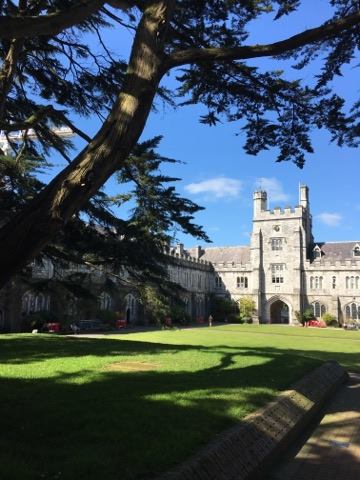
Featured image: UCC campus quad.
Conference reflection

“Well that went well”, the consensus from all involved with the 2019 Textualities conference. Head of the School of English Prof Lee Jenkins described it as one of the highlights of the year, that the lecturing staff are always excited to hear what the graduate students have been researching and learn something new themselves. I very much always feel myself adopting the role of teacher whenever I have to give a presentation and that feeling was emphasized with the addition of a lecture podium and a sizable crowd.

Many of us were nervous as the day of the conference approached, it does not matter how skilled/experienced you are with public speaking, the additional weight of an academic grade will not help the anxiousness. However, from the very first panel at 10pm on Friday 22nd of March it was obvious that all our preparation had paid off. As I stated previously we received useful guidance from Dr Anne Etienne, lecturer in drama and theater which involved practicing our presentations in front of each other.

The first panel which I myself volunteered to chair was about “The Monstrous”, the theme was addressed from many different points of view by students from both MAs covering everything from witchcraft in Shakespeare, to Beowulf, to Mary Shelley to modern superhero movies. The enthusiastic Q/A sessions which followed each panel allowed the speakers to shine and engage with other scholars with similar interests.

My own experience was equally positive, though I did experience a minor technical difficulty with my slideshow I was able to recover. As any actor who fumbles a line during a live performance will tell you, minor mistakes are fine as long as the show continues. The whole experience of the conference was an enriching insight into the true academic world we may become a part of someday and even now I cannot believe it is behind us after so much build up since the new year.

Research Conference 2019

On Friday 22nd of March MA students from the Masters in Modern Literature and Film and Masters in Medieval to Renaissance Literature here at UCC will be presenting their research. The event is open to anyone who would like to come along and show support (thus concludes the advertising portion of this post)

This is particularly exciting for me as I have previously mentioned it was attending this very event last year which made me decide to undertake this MA. Public speaking enjoys a love/hate relationship with most people (let’s be honest) though personally I have never been intimidated by it. This is not because I am a social butterfly, I get tongue tied talking to more than one person in a normal setting but for some reason throughout my undergraduate degree I always found myself not only receiving good grades in presentations but enjoying them. My background is in musical theater. In my teenage years I played leading roles in various musicals and concerts so after singing in front of up to 300 people, giving a 7 minute presentation on a topic I am passionate about in front of a room of people (many of whom I will know) is not as intimidating. I enjoyed our preparatory class given by Dr Anne Etienne, a lecturer in drama and theatre thus confirming my personal thought process of comparing an academic talk to a theatrical performance.

This conference is our top priority for the month of March, which is looking to be particularly busy. I look forward to working with my peers to organize and promote the event and hear about their diverse range of fascinating research topics.

The stage is ours.

Favorite writers: Kurt Vonnegut

“Hello babies. Welcome to Earth. It’s hot in the summer and cold in the winter. Its round and wet and crowded. At the outside, babies you’ve got a hundred years here. There’s only one rule that I know of babies-‘God damn it, you’ve got to be kind'”-Kurt Vonnegut

Following on from my previous piece on James Joyce I thought it would be enjoyable to write about my experience studying another writer whose works I admire, particularly when it is a writer that will play a prominent part in my upcoming conference presentation and thesis. Every writer will tell you it is easier to write when you are genuinely passionate about the subject, or as any student who has had to do an assignment on an area they find dull compared to one that fascinates them can tell you in a heartbeat (right after they meet their deadline).

I find myself constantly referencing the final year of my undergraduate degree, though this is with good reason as I feel it was instrumental in shaping my current literary interests. An invitation from the lecturer who had taught the seminar on Ulysses, Dr Heather Laird, was what brought me to last year’s MA in Literature students’ research  conference and lead me to deciding to pursue this Masters in the first place (and here we are). However, it was not initially in a lecture that I first encountered Vonnegut’s name. I have mentioned previously that one of the things I love about being a literature scholar is that a passion becomes your academic field, thus even when I am not studying some book or film for university I am usually spending my free time reading books or watching movies. Over the 2017/18 Christmas holidays I was reading Ernest Cline’s novel Ready Player One in preparation for the film adaption directed by Steven Spielberg that was going to be released a few months later. The novel is a treasure trove of pop culture references and it just so happened that the protagonist Parzival names his spacecraft after his favorite writer: “The Vonnegut” (naming your spaceship after your favorite writer. I approve). When I read this I knew I recognized the name from somewhere and soon solved the mystery when I looked at my reading list for the following semester, 20th Century American Literature (the module I remember fondly as the best 5 credits of my undergrad) included Breakfast of Champions by none other than a Mr Kurt Vonnegut. Needless to say I was intrigued, any writer whose name appears in a novel which also references Star Wars, Dungeons and DragonsBlade Runner and more should definitely interest an unapologetic nerd like myself.

The fact that I now consider Vonnegut one of my favorite writers (note the title of this blog post) and am in the process of writing my postgraduate using his works as a key focus should tell you what my first experience of reading him was like (I do not know why I attempted to create some suspense there, must be the inner author peaking through). Breakfast of Champions was brilliant, its satirical but accessible writing style conveys deep themes such as a critique of post-war commercialization and consumerism, the theme of freewill which reoccurs throughout many of Vonnegut’s works and ideas of meta-fiction with the writer himself appearing in the story.

I have since made it my mission to read as many of his works as possible in preparation for my thesis, having read his most famous novel Slaughterhouse 5 over the summer and Sirens of Titan and Cat’s Cradle very recently. I was introduced to Vonnegut through reading I was doing in my own time but I became truly fascinated with his writing through my university studies. I don’t bring my work home with me, its always there. As I continue to read his novels and the articles scholars have already published on them I will most likely write a follow up blog post.

The Frozen Deep as Practice-led research with Dr Joanna Hofer-Robinson

This research seminar was particularly interesting for me as the play of focus The Frozen Deep, a melodrama originally scripted by two great writers of the Victorian era, Wilkie Collins and Charles Dickens was one of the texts I studied in the final year of my undergraduate degree for the Victorian Literature module taught by Dr Joanna Hofer-Robinson. I have a background in theater so volunteered to help perform a piece from the play in front of the class of 50+ students, a memorable experience but one which very much encapsulates one of the themes of this seminar “Practice-led research”. As an academic discipline Literature more than many others could be accused of not being at all practice based, as a scholar one reads in a library and then writes. However, when it comes to something like drama which by its very nature was not meant to simply be read but performed, spoken aloud to an audience. This is relevant to my own area of study as many works of Modernism such as T.S. Eliot’s The Waste Land and James Joyce’s Ulysses have lead themselves spectacularly well to oral performance over the years.

The history of the play itself is as captivating as the narrative as Dickens himself not only took on the role of one of the chief characters Wardour, the vengeful “other man” but was apparently meticulous in its staging as a Christmas entertainment. The play would even go on to be performed for Queen Victoria herself. Dr Hofer-Robinson went on to recount her own experience of co-directing a performance of the play herself at Senate House Library in 2016 to learn more about Dickens and 19th Century theater through practical engagement. She discussed the various acting techniques that were used in Victorian melodrama to elicit a felt response in the audience; gestures and facial expressions used to convey specific emotions such as joy or fear, thus displaying them to full effect without the use of words.

As someone who has worked in theater and has studied drama modules since the beginning of my university career I have a great appreciation for how effective this practice led research could be in gaining a greater understanding of texts. When studying a novel or poem I always get as much out of discussions with lecturers and classmates as I do from my own interpretations. In this sense performing plays, speaking the words aloud as their writer had intended seems the best way of appreciating drama as its own art form. Though it may be a case that some of us may be a little more hesitant to sharpen our rusted acting skills in front of our peers. As Oscar Wilde once said “I regard the theater as the greatest of all art forms, the most immediate way in which a human being can share with another the sense of what it is to be a human being”

Time for a topic

Having given the subject of my thesis topic a great degree of thought over the Christmas holidays (a Master’s degree of thought if you will) I believe I finally have the seed of an idea that I may plant in the soil of my brain and water it with research to make the thesis flower bloom…yes this is the mediocre wordplay and analogy blog post.

In all seriousness the question I asked myself when I genuinely found myself at a loss as to what exactly I wanted to write about was simply this: “What am I interested in?” It is a simple enough query but one I would urge any future students on this or any other MA in Literature program to ask themselves if like me they find themselves, more than anything else spoiled for choice. This is as I have previously mentioned, most likely due to the fact that I completed my undergraduate degree as a BA (Single honors) in English, thus have studied a wide range of literary periods, movements and genres.  However, inspiration came once again from one of the special studies seminars I completed as part of my degree (I have said before that I consider them to have been one of the highlights of the 3 year course for me) specifically the seminar on 20th Century American Science Fiction which I took barely a year ago in my final semester of final year. Science fiction has long been one of my favorite genres of literature and film but it was never something I had considered studying, having the mindset of not wanting to mix texts read for pleasure in my own time with what I was analyzing critically as a scholar (I find myself being reminded of Mr Wemmick from Charles Dickens’s Great Expectations, my personal favorite of his works) However, as it happened I was drawn to the seminar in question for the wide range of interesting texts being studied and soon realized how fulfilling combining my interests could be.

For so long I have always been fascinated with books, films, series etc featuring time travel. As part of my seminar I presented on a 1960s serial from the long running series Doctor Who, which I felt related to the themes we had been covering and it was great to speak about a personal passion in an intellectual setting. All this came to mind during the holidays when I was considering what my thesis topic should be, how can I recreate the same passion with which I wrote that 7 minute long presentation for the 15000 word piece I must write this summer?

I have found the answer by reflecting on my past experiences and now I look to the future when the seed of this idea will bloom. Write about time travel in literature and film?

Why not?

Editing assignment reflection

As part of our research skills module EN6009, both MA classes Medieval to Renaissance and Modernities were tasked with editing pages of Wikipedia relevant to our research area. This was challenging as it brought to light how close we are coming to choosing a solid thesis topic. I had some ideas having given my thesis some degree of reflection over the Christmas holidays and knew it would be best to focus on an area that I have a broad knowledge of and in doing so might contribute something of worth. Recently I have simply been asking myself “What do you like? What interests you? What could you discuss at length?” Simple self reflective questions to be sure but they did in fact lead me to a possible topic of interest which I will explain in greater details in another blog post, essentially it involves the theme of time travel and the works of two of my favourite writers.

However, I found this assignment difficult as I was at a loss as to what I could add/change about entries relating to my areas of interest as all pages already seemed well written and fleshed out. Despite great support/assistance from lecturers it was simply not something I felt able to complete.

Though I appreciate the overall purpose of the assignment, which was to gain experience editing pages of information on areas we are striving to become scholars in, it was difficult to complete for me personally due to the aforementioned lack of ideas and not having my own laptop present, thus left with no other option but to attempt the assignment on my tablet.

As with all assignments successful or not this was a learning experience and has reminded me that at this level of study there will always be assignments that challenge you or put you outside of your comfort zone and the best course of action is simply to see it through and as I have mentioned before, not be afraid to ask for help.


1st semester in review

As I come to the end of 2018 I look back on everything I have experienced on the Masters programme so far while looking to the next semester and what it will bring.

Selecting a thesis topic is of course my main priority as we will be presenting on our research interests at the MA conference in March. I feel I am getting closer to deciding on an area that I feel is very worthy of exploration. I am also looking to the 2nd semester modules and am particularly excited about the section dealing with post-modernism and film. Cinema is a life long passion of mine and I always enjoyed getting the opportunity to study film academically, the unique critical language is similar to that used when analysing works of literature but also so different. I always find it challenging to write about film in this way, especially since reviewing movie and television releases for the university paper has been an extra-curricular activity of mine since beginning university, thus a more informal journalistic style of writing is naturally in my head. Undoubtedly I will write a piece in the near future relating to that section of the module as I have looked at the reading list and the films studied may be relevant to my own research interests, as I have made my special interest in book to screen adaptation known previously.

As the festive season is just around the corner I am also looking forward to some time off but as this MA has become such a large part of my life, ideas will no doubt be going through my head even as I sit down to open presents (mostly books)

I will return in early January to UCC and this blog ready to begin 2019: The year I complete my Masters in Modern Literature and Film

Seeking advice from lecturers

At the beginning of the MA our class was given a list of the staff members of the UCC School of English which included each of their individual research areas and interests. As someone who was an undergraduate at this very university last year I was familiar with most of the lecturers and have taken many of their classes. Thus I did not hesitate to get in contact with them early to discuss possible thesis topics, though I admit I had very few real ideas at this early stage.

Dr Miranda Corcoran, with whom I had studied American Literature and a special studies seminar on science fiction written in the era post-World War 2, and Dr Joanna Robinson who lectures on Victorian Literature were both extremely helpful. I got a sense of what the thesis writing process would be like and began to appreciate that while 15000 words may seem long, focusing on a single topic in such depth will make use of every single word. Seeking advice from lecturers with such a broad range of interests brings to light the main issue for me in choosing a thesis topic; after studying such a wide variety of works in undergraduate, it is more difficult now to narrow my focus.

With the advice they gave me, along with reading recommendations that could prove useful to the interests I spoke to them about I feel more confident that eventually I will settle on a topic I wish to write on. I would advise all of my classmates and fellow graduate students to take the time to speak to your lecturers outside of class.

Create a free website or blog at WordPress.com.

Up ↑

Scribe Five

“What is better than wisdom? Woman. And what is better than a good woman? Nothing.” - Geoffrey Chaucer

Chronicles of a Bibliophile

The Research Ramblings of a Sanguine Student

Sonnets, Stars and Shakespeare

An MA student's journey to a completed thesis

Design a site like this with WordPress.com
Get started